 Huzzah
Articles of Capitulation, York, 19 October 1781
October 19, 1781 | Earl Cornwallis, with the answers of the allied commanders | York, Virginia
The sheet
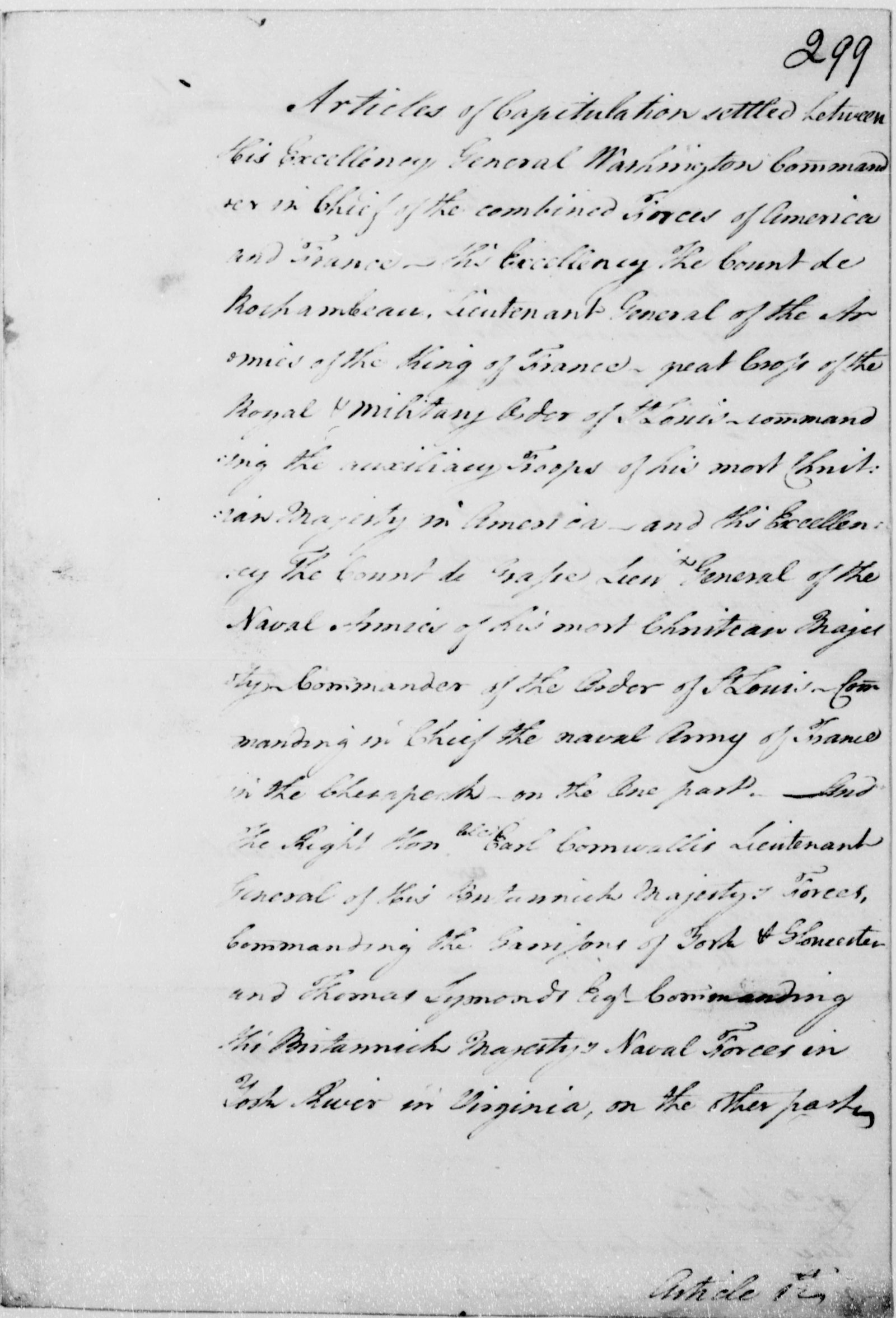
The copy Congress received. Articles of Capitulation, York, 19 October 1781. The first of ten pages, folio 299, in the copy Washington sent to the President of Congress with his letter of the same day. National Archives, Papers of the Continental Congress, Item 152, volume 10. Photographed from microfilm; image provided to the National Archives by Fold3. The text below is set from this copy.
Written in 1781, the page is in the public domain, and the National Archives catalog marks its use Unrestricted. The volume at the National Archives
The document
Ask Poor RichardArticles of Capitulation settled between His Excellency General Washington Commander in Chief of the combined Forces of America and France—His Excellency the Count de Rochambeau, Lieutenant General of the Armies of the King of France—great Cross of the Royal & military Order of St Louis—commanding the auxiliary Troops of his most Christian Majesty in America—and His Excellency the Count de Grasse Lieut General of the Naval Armies of his most Christian Majesty—Commander of the Order of St Louis—Commanding in Chief the naval Army of France in the Chesapeak—on the one part—And the Right Honble Earl Cornwallis Lieutenant General of his Britannick Majesty's Forces, commanding the Garrisons of York & Gloucester and Thomas Symonds Esqr Commanding his Britannick Majesty's Naval Forces in York River in Virginia, on the other part.
Article 1st
The Garrisons of York and Gloucester, including the Officers & Seamen, of his Britannick Majesty's Ships, as well as other Mariners, to surrender themselves Prisoners of War, to the combined Forces of America and France—the land Troops to remain prisoners to the United States, the Navy to the naval Army of his most Christian Majesty.—
Granted.
Article 2d
The Artillery, Arms, [Accoutrements?], Military Chest, and public Stores of every Denomination, shall be delivered unimpaired, to the Heads of Departments appointed to receive them.—
Granted.
Article 3d
At 12 OClock this Day—the two Redoubts on the Left Flank of York to be delivered—the One to a Detachment of American Infantry—the other to a Detachment of French Grenadiers—the Garrison of York will march out to a Place to be appointed, in Front of the Posts at 2 OClock precisely, with shouldered Arms, Colours cased, and Drums beating a British or German March—they are then to ground their Arms, & return to their Encampment, where they will remain untill they are dispached to the Place of their Destination.——Two Works on the Gloucester Side, will be delivered at One OClock to Detachments of French and American Troops appointed to possess them—the Garrison will march out at three OClock in the Afternoon, the Cavalry with their Swords drawn, Trumpets sounding—& the Infantry in the Manner prescribed for the Garrison of York—they are likewise to return to their Encampment untill they can be finally marched off.——
Granted.
Article 4th
Officers are to retain their Side Arms—both Officers & Soldiers to keep their private property of every kind, and no part of their Baggage or papers to be at any Time subject to search or Inspection—The Baggage & papers of Officers & Soldiers taken during the [Siege or Seige], to be likewise preserved for them—It is understood that any Property obviously belonging to the Inhabitants of these States, in the possession of the Garrison, shall be subject to be reclaimed.—
Granted.
Article 5th
The Soldiers to be kept in Virginia, Maryland or Pennsylvania, & as much by Regiments as possible, and supplied with the same Rations of Provisions as are allowed to Soldiers in the Service of America:—a field Officer from each Nation, viz British, Anspach & Hessian, & other Officers on parole, in the proportion of one to fifty Men, to be allowed to reside near their respective Regiments, to visit them frequently, & be Witnesses of their Treatment—And that these Officers may receive & deliver Cloathing & other necessaries for them, for which, Passports are to be granted when applied for.—
Granted.
Article 6th
The General Staff & other Officers, not employed as mentioned in the above Article, and who chuse it, to be permitted to go on parole to Europe, to N York, or to any other American maritime ports, at present in the possession of the British Forces, at their own Option; and proper Vessels to be granted by the Count de Grasse, to carry them under Flags of Truce to N York, within ten Days from this Date, if possible, and they to reside in a District to be agreed upon hereafter untill they embark—The Officers of the civil Department of the Army and Navy to be included in this Article—passports to go by Land to be granted to those, to whom Vessels cannot be furnished.—
Granted.
Article 7th
Officers to be allowed to keep Soldiers as Servants, according to the common practice of the Army—Servants not Soldiers are not to be considered as prisoners—and are to be allowed to attend their Masters.—
Granted.
Article 8th
The Bonetta Sloop of War to be equipped & navigated by its present Captain & Crew, & left entirely at the Disposal of Lord Cornwallis, from the Hour that the Capitulation is signed, to receive an Aid de Camp to carry Dispaches to Sir Hy Clinton & such Soldiers as he may think proper to send to N York, to be permitted to sail without Examination, when his Dispatches are ready—His Lordship engaging on his part, that the Ship shall be delivered to the Order of the Count de Grasse, if she escapes the Dangers of the Seas—that she shall not carry off any public Stores—any part of the Crew that may be deficient on her Return, & the Soldiers, Passengers, to be accounted for on her Delivery.—
Granted.
Article 9th
The Traders are to preserve their property, and to be allowed three Months, to dispose of, or remove them,—and those Traders are not to be considered as prisoners of War.—
The Traders will be allowed to dispose of their Effects—the Allied Army having the Right of pre-emption, the Traders to be considered as prisoners of War on parole.—
Article 10th
Natives or Inhabitants of different parts of this Country at present in York & Gloucester are not to be punished on account of having joined the British Army.—
This Article cannot be assented to, being altogether of civil Resort.—
Article 11th
Proper Hospitals to be furnished for the Sick & Wounded—they are to be attended by their own Surgeons on parole, & they are to be furnished with Medicines & Stores from the American Hospitals.—
The Hospital Stores now in York & Gloucester, shall be de[livered] for the Use of the Bri[tish] Sick & Wounded—pass[ports] will be granted for pro[curing] them further Suppl[ies] from New York as Occasio[n] may require—and prope[r] Hospitals will be furnishe[d] for the Reception of the Sick & wounded of the two Garriso[ns].
Article 12th
Waggons to be furnished to carry the Baggage of the Officers attending the Soldiers, and the Surgeons when travelling on Account of the Sick, attending the Hospitals, at the public Expence.—
They will be furnished if possible.—
Article 13th
The Shipping & Boats in the two Harbours, with all their [unread: an ink smear], Tackling, & Apparel, shall be delivered up in their present State to an Officer of the Navy appointed to take possession of them, previously unloading the private property, part of which had been on Board for Security during the [Siege or Seige].—
Granted.
Article 14th
No Article of the Capitulation to be infringed, on pretext of Reprisal—and if there be any doubtfull Expressions in it, they are to be interpreted according to the common Meaning & Acceptation of the Words.—
Granted.
Done at York in Virginia this 19th Day of October 1781—
Cornwallis
Thos Symonds
Copy
Source and provenance
Transcribed for Huzzah from the manuscript copy in the National Archives, Papers of the Continental Congress, Record Group 360, Item 152, volume 10, folios 299 to 307 (catalog images 252 to 261, NAID 502988231). This is the copy Washington enclosed with his letter to the President of Congress of the same date, which precedes it in the volume. The catalog marks its use Unrestricted. The docket on the outer fold reads Articles of Capitulation. The text was read from the page images and collated word by word against the Early Access transcription at Founders Online (Washington Papers, 99-01-02-07199), which is of a different copy, held in the British Public Record Office. This transcription is that collation, not only a copy of one text. The two copies differ in fourteen places of substance. The Congress copy closes Done at York in Virginia and carries the signatures of Cornwallis and Thomas Symonds, marked Copy; the Public Record Office copy closes Done in the Trenches before York and carries the signatures of Washington, Rochambeau, Symonds and Barras. The Congress copy has no blank after this Day in Article 3; reads the Place of their Destination; viz for to wit in Article 5; Rations of Provisions; the above Article, singular; maritime ports, where the Public Record Office copy and the Avalon Project read posts; the civil Department, singular; to those, to whom; the common practice of the Army for of the service in Article 7; and the Surgeons, and at the public Expence, in Article 12. Its preamble has nothing where Founders Online supplies His Excellency in brackets. Spelling, abbreviation and ampersands are the manuscript's, including untill, dispached and Dispaches. Letter case follows the manuscript as far as it can be determined and is uncertain in places. In the manuscript the answers stand in a column to the right of each article; here each answer is set beneath its article. A word interlined in Article 5, the, is printed in its place. Square brackets are ours. In the answer to Article 11 they supply letters lost at the edge of the page. In Article 13 an ink smear covers one or two words, printed as a gap; Founders Online and the Avalon Project both read stores, guns there. The spelling of Accoutrements in Article 2 could not be read with certainty. In Articles 4 and 13 two careful readings disagree between Siege and Seige: one made at 1,600 pixels across the page and one at the catalog's full resolution, 2,464 and 2,594 pixels across a microfilm scan, which is the largest the National Archives serves. At full resolution, in Article 13 a dot stands over the letter immediately before the g, which places the i third and favors Seige; in Article 4 no dot is clear, so the two instances do not corroborate each other. Both are marked alike in the text. The meaning is not in doubt, and the word is printed as Siege or Seige in brackets. The editorial apparatus of Founders Online is not reproduced.
Read next: The Preachers and the Revolution, 7 books in The Formation Library.