 Huzzah
The Bill of Rights
December 15, 1791 | The First Congress | New York, New York
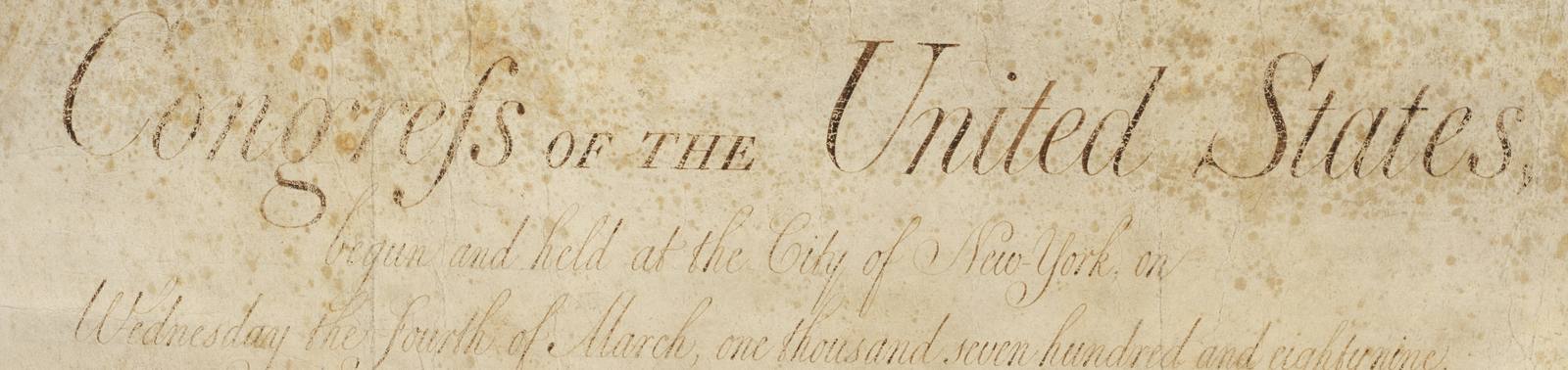
A detail: the heading of the engrossed resolution of 25 September 1789, in which Congress proposed twelve articles of amendment. The ten printed here are the third through the twelfth, as the states ratified them. National Archives, Record Group 11. The National Archives page for this document
In parts
Each part is a unit that ends. They are places in the text below, not summaries of it.
- Amendment IReligion, speech, press, assembly, petition
- Amendment IIA militia, and the right to keep and bear arms
Both witnesses print three commas. The readings with fewer commas, which the legal argument turns on, appear in printings this library has not read: see the source and provenance note.
- Amendment IIINo quartering of soldiers in a house
- Amendment IVSearches, seizures and warrants
- Amendment VGrand jury, double jeopardy, self incrimination, due process, taking
Five separate protections in one sentence, which is why it is the amendment most often cited by only one of its clauses.
- Amendment VIA speedy public trial, and the accused's own witnesses
- Amendment VIITrial by jury in civil suits
- Amendment VIIIBail, fines and punishments
- Amendment IXRights not listed are still rights
Written to answer the objection that listing rights would imply the list was complete.
- Amendment XWhat is left to the states and the people
The last of the ten, and the one the ratifying conventions asked for most often.
The document
Ask Poor RichardAmendment I
Congress shall make no law respecting an establishment of religion, or prohibiting the free exercise thereof; or abridging the freedom of speech, or of the press; or the right of the people peaceably to assemble, and to petition the Government for a redress of grievances.
Amendment II
A well regulated Militia, being necessary to the security of a free State, the right of the people to keep and bear Arms, shall not be infringed.
Amendment III
No Soldier shall, in time of peace be quartered in any house, without the consent of the Owner, nor in time of war, but in a manner to be prescribed by law.
Amendment IV
The right of the people to be secure in their persons, houses, papers, and effects, against unreasonable searches and seizures, shall not be violated, and no Warrants shall issue, but upon probable cause, supported by Oath or affirmation, and particularly describing the place to be searched, and the persons or things to be seized.
Amendment V
No person shall be held to answer for a capital, or otherwise infamous crime, unless on a presentment or indictment of a Grand Jury, except in cases arising in the land or naval forces, or in the Militia, when in actual service in time of War or public danger; nor shall any person be subject for the same offence to be twice put in jeopardy of life or limb; nor shall be compelled in any criminal case to be a witness against himself, nor be deprived of life, liberty, or property, without due process of law; nor shall private property be taken for public use, without just compensation.
Amendment VI
In all criminal prosecutions, the accused shall enjoy the right to a speedy and public trial, by an impartial jury of the State and district wherein the crime shall have been committed, which district shall have been previously ascertained by law, and to be informed of the nature and cause of the accusation; to be confronted with the witnesses against him; to have compulsory process for obtaining witnesses in his favor, and to have the Assistance of Counsel for his defence.
Amendment VII
In Suits at common law, where the value in controversy shall exceed twenty dollars, the right of trial by jury shall be preserved, and no fact tried by a jury, shall be otherwise re-examined in any Court of the United States, than according to the rules of the common law.
Amendment VIII
Excessive bail shall not be required, nor excessive fines imposed, nor cruel and unusual punishments inflicted.
Amendment IX
The enumeration in the Constitution, of certain rights, shall not be construed to deny or disparage others retained by the people.
Amendment X
The powers not delegated to the United States by the Constitution, nor prohibited by it to the States, are reserved to the States respectively, or to the people.
Source and provenance
Text from the National Archives transcription of the Bill of Rights, at https://www.archives.gov/founding-docs/bill-of-rights-transcript, read on 17 September 2026. That page prints both the engrossed resolution, whose articles are numbered first to twelfth, and the ten ratified amendments as they are conventionally numbered. The ten here are the conventional numbering, and the note above records the offset. Collated word by word against the Avalon Project's text, Lillian Goldman Law Library, Yale Law School. The two agree on every word of all ten amendments. Across 464 words they differ in 12 places of capitalization, and in six other places: this text keeps the Archives' "well regulated", "offence", "defence" and "re-examined" where Avalon prints "well-regulated", "offense", "defense" and "reexamined", and it keeps two commas Avalon drops, after "for public use" in the Fifth Amendment and after "tried by a jury" in the Seventh. The Second Amendment's commas carry legal weight, so they are stated here. Both witnesses print three, as this text does. "A well regulated Militia, being necessary to the security of a free State, the right of the people to keep and bear Arms, shall not be infringed." Readings with fewer commas exist in state ratification copies and in period printings that this library has not read, and the dispute over what the punctuation does to the meaning is not resolved here. It is recorded. Avalon's page also carries its editor's own captions inside the text, such as "II - Right to keep and bear arms". Those are the editor's words and none of them is here, the same rule this library applied to Thornton and to Avalon's Constitution pages. The place is the source's own. The engrossed resolution on the Archives' page opens "Congress of the United States begun and held at the City of New-York". The date is ratification, in December 1791, and the place is where Congress proposed the articles two years earlier, which is why the two do not match and why both are stated here.
Read next: The Formation of the Free Mind, 5 books in The Formation Library.